- Josh's Newsletter
- Posts
- Yesterday Today Tomorrow Forever
Yesterday Today Tomorrow Forever
Recommended Books January 2026

Josh Cook
January 23, 2026

Hello Readers,
I’m a little later than I like to be this month. Not that I really owe anyone an explanation, but I’ve been working on an essay I’m excited about that I’m thinking of turning into a zine. (We’ll see.) At the moment, I’m also going over and over and over again what I would say to ICE agents if they came to the store, all the ways I would stick to script. I’m visualizing myself staying calm. I am reminding myself that anger is not always best deployed as anger. I am thinking “Cold. Stone cold.” I am thinking, “What would make my son proud?”
I believe that we still have some really hard times ahead of us. But I also believe that we are making a lot more progress and achieving a lot more victories than it feels like we have. I believe there is even more going on in Minneapolis, Chicago, L.A., everything than we see and all of that will add up to some power and important positive change in the not too distant future.
I am also thinking about and still believe in books. We all need our anchor after all. This month, I’ve got a little mini-theme, a front runner for weirdest book of 2026, and another in my now classic “Buy it despite knowing I’ll never finish it,” genre of Forever books.
Keep going.
Josh
P.S. If you like what I’m doing here the best way to support it is to help grow the list of subscribers, so share the sign up link around. Thank you!
YESTERDAY
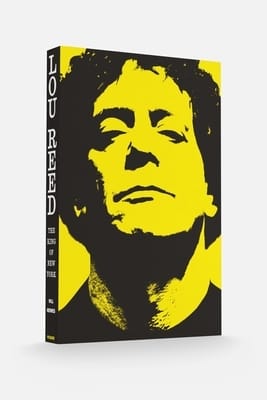
Lou Reed: King of New York by Will Hermes
I honestly, haven’t put a lot of thought into the idea of the “art monster.” It’s always seemed to be a tool to apologize for sexist, racist, cruel actions by white men who also happen to make art that some people like. Whether the mechanism of the apology is that there art somehow drives their bad behavior or the mechanism is that genius needs freedom, the result is usually a white guy gets away with things. I’m also not sure what the idea adds to our understanding about the art in question. That said, there certainly are artists who struggled with mental illness and personal traumas, who also made great art, while also taking their pain out on other people, making poor even dangerous decisions, and self-medicating with whatever they could get their hands on. I suspect that ultimately, artists have the same distribution of trauma, mental health crises, and bigotry as everyone else, but we just don’t hear about the shit our neighbors do or go through.
In Will Hermes’s biography, Lou Reed is the later form of art monster and though Hermes doesn’t apologize or directly correlate Reed’s mental health with harm he did to himself and others, Reed’s struggles with depression (likely getting shock therapy as a teenager) and his gender identity are always in the background. Or maybe I just really like Lou Reed’s art and, not unlike the people I’m critiquing above, I’m searching for justifications.
Either way, Lou Reed is a fascinating artist (and one of my favorite musicians) and a fascinating person and Hermes does a good job of getting out of the way of his material and letting the principle characters and the events that surround them speak through. I don’t know if I’d recommend this someone who isn’t already interested in Lou Reed or the music and culture scenes he helped build, drive, complicate, but I’m a fan of his and I’m enjoying the book. And that can be enough sometimes.
TODAY
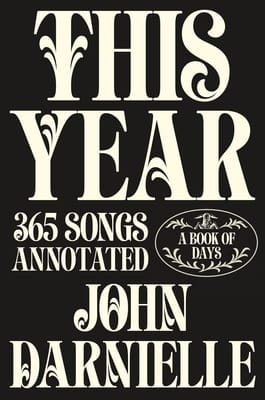
This Year: 365 Songs Annotated by John Darnielle
Back when Twitter was good, I sold John Darnielle a Dogman stuffed animal through PSB’s account. (I am actively not thinking about how old the ultimate recipient of that Dogman is now.) That’s not why I’m featuring his latest book this month, though I certainly won’t pass up the opportunity to tell that story.
Recently, I’ve been thinking a lot about…thinking, how certain methods of making sense of the world (or the absence of a method for making sense of the world) leaves us more or less vulnerable to exploitation by capitalist, fascist, and bigoted systems of power and ideologies. Because I’m me, I’m thinking of all the different ways we can use reading and even more so writing, to essentially build a Trump-proof, AI-slop proof brain. So I’m on the look out for projects, techniques, strategies, experiments that create opportunities for deep engagement with ideas through writing. So I love how Darnielle is choosing to explore his life and work; using a Book of Days/Devotional structure to consider 365 of his songs. I think it’s a method that other artists can apply to their own works and life whether it ends up producing a publishable book or not. It also feels like fan service in the best possible way.
It’s also, you know, something anyone could do. As we all look for ways to take back our brains from attention economy and AI slop internet, you could do worse than writing about a different song every day for a year.
We are gonna make it through this year, if it kills us.
TOMORROW
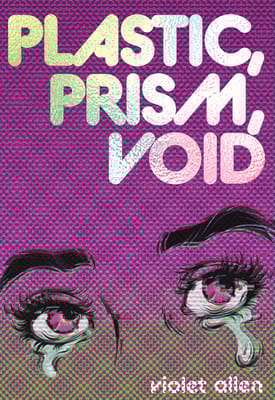
Plastic, Prism, Void: Part 1 by Violet Allen
I’m really excited for more people to read this book so they can help me figure out what the fuck it is. The publisher copy does a good job with the some top line, eye-catching descriptions. “Combining Sailor Moon, Sex and the City, and House of Leaves” feels right to me, even though I’m only really familiar with House of Leaves, as does "This Is How You Lose the Time War but on crack." --Jace Molloy even though I haven’t read Time War either. But there’s an element to the prose style that I don’t think is really captured by the copy and blurbs. It is also, unapologetically, almost aggressively literary.
Along with being a magical moth goddess, the protagonist is a poet, so Allen garners some permission for literary references there. But Acrasia doesn’t limit her references to poetry and she certainly doesn’t deploy them the way one might assume a poet does. (Well, maybe if we’re talking John Ashbery or Edna St. Vincent Millay if they’re feeling saucy). In fact, that undercurrent (yes, the current under the Gundam suit, multiverse resonances, second narrator from the mirror dimension, and the layout stuff that brings up the House of Leaves comps) reminds me most of…Lina Wolff, who can be so precisely and beautifully mean that you would almost feel bad for her targets if it wasn’t so immediately clear they deserve it.
I don’t have any idea where the book is going and with some Dr. Who time-looping seeming to happen, this might not be a book that really has any interest in “going,” or perhaps might even argue that “going” both as a fact of life and a fact of literature is actually an illusion. I’m also not sure about the whole “Part 1” business, but Plastic, Prism, Void, Part 1 has a ton of really cool stuff going on and I’m excited for you all to encounter it when it comes out in May.
FOREVER
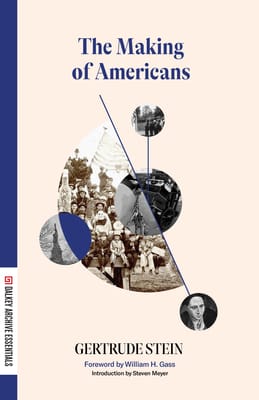
The Making of Americans by Gertrude Stein
Tender Buttons rewired my brain. Though my love of James Joyce and modernism in general meant I was well aware of Stein as an important figure in modernist and English language literature, I wasn’t actually motivated to read Tender Buttons until Ben Marcus discussed it in his epic response to Franzen’s Mr. Difficult. (How’s that for a string of references!) Somehow, the way, Stein repeated and manipulated the relatively limited lexicon pushed against the intellectual architecture I had for reading. It was less that I didn’t understand the prose (though there certainly were sentences and passages that lost me) and more that the text seemed to be operating within or towards an entirely different method of understanding than the one I was equipped with. It’s one of those books that reminds us that, no matter how far it feels like we’ve come in terms of exploring the potential in literature, we’ve actually just barely scratched the surface.
I’ve only gotten as far as the first introduction to The Making of Americans, but it poses a question I kind of know the answer to: Can I read a thousand pages of Tender Buttons? Having read some absolute chonkers in my life, I know the rewards that can come from sticking with a long project as an author develops an idea or series of ideas over hundreds of thousands of words. Specifically, knowing what it feels like when all of Proust’s threads finally come together near the end of In Search of Lost Time, makes me more than a little curious, both about what Stein is actually even attempting with the book, and whether and if so how she pulls it off.
But there is no way I can only read The Making of Americans and I’m pretty sure that’s the only way I’d be able to finish it. So, I’ll just pick and poke at it along with all of my other reading and writing and I’ll get some way through it and eventually one of those picks and pokes will be the last time I read from The Making of Americans, either because I’ve finished it or…something else.
I’ve seen this idea expressed a few different ways (I may have said it here myself) but part of the whole point of the Forever section in the newsletter is that we shouldn’t always think of books we don’t finish as “failures,” either of the book or of our reading. Sometimes a books gives you everything you need from it in the first half. That’s still something to be grateful for.